
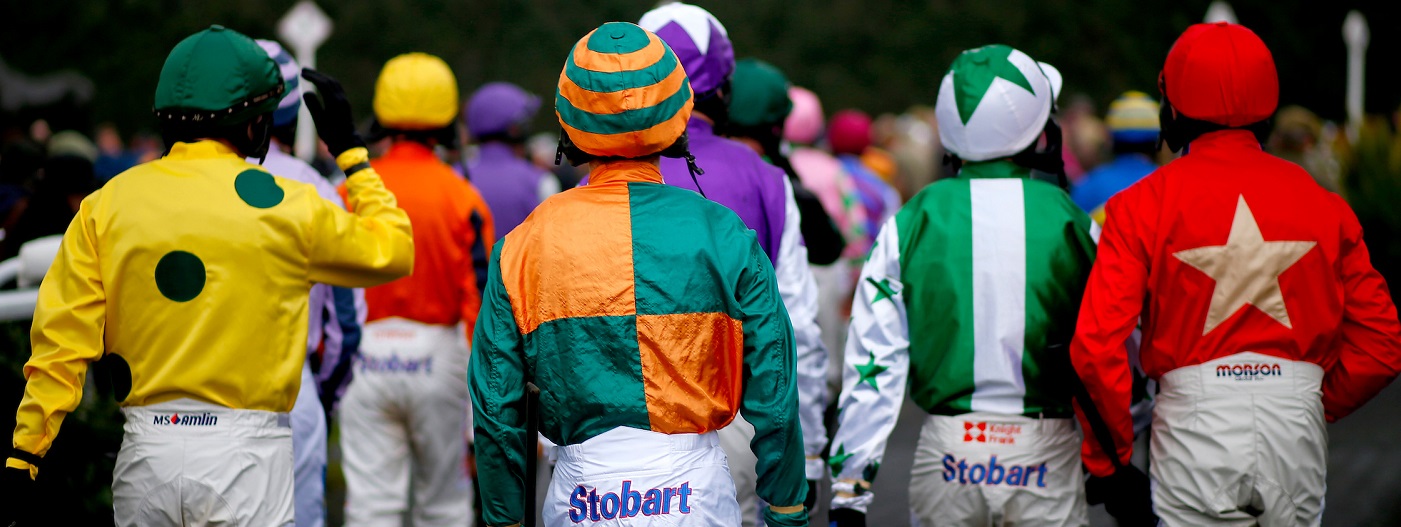
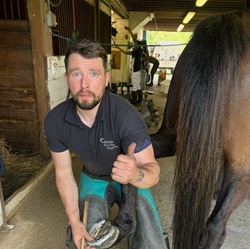
Killian came from Ireland to ride in England aged 19 and was based in Cotswolds for around 10 years. He rode 75 winners for trainers including Sophie Leech, Jonjo O’Neill, Martin Keightley and Graeme McPherson and successfully rode out his claim. He stopped riding in 2019 and returned to Ireland where he has recently completed his Worshipful Company of Farriers International Diploma and is now working in County Meath.
What made you decide to pursue a second career in farriery?
I have a cousin and lots of friends who are farriers so I was always interested in farriery as a job. I’d originally wanted to do my apprenticeship in England, I was working for Andy Martin but unfortunately without English and Maths GCSEs I couldn’t apply to any colleges so I moved back to Ireland to study there.
How did you set about getting your qualification?
I applied for a place at CAFRE (College of Agriculture, Food and Rural Enterprise) in Enniskillen. I was able to do a farriery upskilling course alongside getting practical experience. I have just completed a Worshipful Company of Farriers diploma which involved a theory, oral and practical examination.
What support have JETS given you?
JETS have been a great support. They contributed towards college fees and exams which are expensive enough so that’s a massive weight off the shoulders. Also whether it was Lisa before or Rachel now, they’ve always been there at the end of the phone for me. When I’ve had a problem, they’ve put me at ease and that’s a great relief especially when we’re such last minute merchants us jockeys! Rachel had big shoes to fill when Lisa left but she’s been really supportive and I’m sure she’s going to do a great job for jockeys.
How did you find the studying aspect of farriery?
I was never very good at school, I’d rather be hands on so it was daunting getting back into books but the big thing was figuring out how to process information. I’m a bit dyslexic so, with the support of the college, I worked out that I needed to do a lot more visual learning, doing anatomy drawings and watching videos to help me get a picture in my brain. It takes a while but you just have to keep your head down, don’t panic and do little bits at a time.
What do you most enjoy about farriery?
I really like the shoe making competitions. What I miss most about being a jockey isn’t the riding but being with the other lads in the weighing room, you can’t get that close knit community anywhere else but the shoeing competitions are similar, being with the other lads and having a bit of fun together.
What has been the most challenging aspect?
I was 29 starting an Apprenticeship and you feel like you’re a bit of a nobody and you’ve lost your identity as a jockey so you have to go back to basics, accept you’re not good at something but you just have to keep your head down and you may make mistakes like you did when you were a jockey but you move on and things get better. Every day is a learning day but I have lots of people I can turn to for advice and the qualification has given me a new level of confidence.
What advice would you give to other jockeys?
I would just start doing other things as early as possible. Once you’ve started learning, even just doing the smallest course, like a chainsaw course or media training, there’s a snowball effect which can get you going. It doesn’t have to be an apprenticeship, it’s good just to get the ball rolling and it looks good on your CV. You can’t ride forever.
What transferable skills as a jockey have helped you in your second career?
Being able to talk to owners and communicate and also handling horses on a regular basis gives you confidence in your work.
What is your plan for the future?
I’m building up the business, working on all types of horses. I know I could take this skill anywhere there are horses if I wanted – Dubai, Australia who knows, it’s a real asset to have this training completed.