
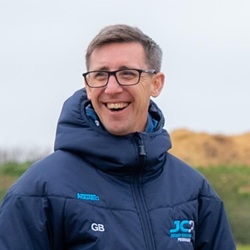
George Baker’s successful career as a Flat jockey came to an abrupt end after a serious accident riding in St. Moritz in 2017 aged 34. Along with his media work for Racing TV, he has since forged a second career in coaching, gaining his qualifications with the help of JETS before becoming a Regional Coach and playing an integral role developing the Jockey Coaching Programme. In January 2026, he started a new role as Head of Coaching for the Rider Development Pathway, an initiative delivered by the British Racing School designed to optimise rider skills in yards across the country.
How did your career in coaching begin?
When I had my fall, I’d had my best year as a jockey, I was managing my weight sensibly and I was aiming to ride until I was 40. When it came to announcing my retirement from riding on Sky Sports, a few opportunities came along but I was not as well prepared as I should have been. I’d had a lot of rides for Jamie Osborne and he approached me about doing some coaching for his daughter Saffie who was about to embark on her Apprentice career so it began from there, it wasn’t something I’d thought of doing but I found I really enjoyed it.
How did JETS help you?
I was still in my rehabilitation when I first spoke with Lisa (former JETS Manager). I knew I needed to upskill particularly when it came to emails, my grammar wasn’t great and so she organized a course for me to improve my writing and computer skills. Then with the coaching, Lisa helped me with a course to gain my Level 1 and Level 2 coaching qualification. I took on more jockeys and in 2021 I completed my Level 3, again with the help of JETS.
How did your Coaching Career progress?
When I started, there were no employed coaching roles with the security that comes with that. As the Jockey Coaching programme evolved, it was clear there needed to be more structure and accountability around coaching and in 2022, I became one of the main employed full time Regional Coaches for the Lambourn area. The Regional Coaches allowed us to create a much more professional environment and enabled us to look after a much broader pool of jockeys with the introduction of Coaching Drop In sessions at the IJF Centres.
What are the biggest changes in Jockey Coaching that you’ve noticed?
There’s definitely been a change in attitude with jockeys really seeing themselves as professional athletes now. The wider support network for jockeys is excellent and through the Jockey Coaches, we’re able to signpost jockeys correctly to the support they require, whether that’s when things are going well and they are optimizing their performance but also when things aren’t going well and they need different types of support. Ultimately, the whole programme aims to ensure that today’s jockeys have longer and more successful careers and when they walk away at the end they’re not wishing they could have another go. As Coaches too we’re being developed too for example with our first staff training week which will help us all and make sure that jockeys are getting the best possible help.
What is the Rider Development Pathway and your role within it?
It has been designed to help improve the overall standard of riding in racing yards, as part of the Horseracing Industry People Board’s Careers strategy led by Eleanor Boden. It is being administered by the British Racing School and I’m the Head of Coaching travelling to yards usually three days a week. It is being rolled out in yards using a rider competency matrix to standardize rider skills and to identify what level they’re at so that through coaching support, they can improve their skills and move up to the next level. Usually four or five riders go through the programme at any one time and each yard has a rider coach assigned who will record riding out, be aware of what each rider is working on and be on hand for help or advice.
Yards who’ve signed up so far say it’s been massively helpful. Everyone’s working together and it’s really constructive. For example three of the five riders on the pathway from Mark Loughane’s yard have gone up to the next level, allowing them to ride a bigger pool of horses and allowing new staff to come into the pathway so yards aren’t clogged up with staff who can only rider the easy horses. It is very much tailored to each yard working with the trainer to understand their approach ultimately ensuring that their horses are ridden better and perform better on the track but also working with the rider as individuals and understanding the way they ride so they can be seen to the best effect.
Can jockeys take part?
Yes, a good example is Ian Williams’ yard where the Assistant Trainer and Ryan Kavanagh, his Apprentice are the rider coaches. It’s great for jockeys who want to upskill themselves, gain new experiences and add to their CVs. Sometimes, jockeys may then want to take it further for example Jack Loughnane has his Amateur licence and now is keen to get his coaching qualifications.
What do you find most satisfying about Coaching?
Obviously working with Joe Leavy last year and seeing him improve and become Champion Apprentice is lovely but I get as much satisfaction going into yards and seeing a massive pool of riders improve in their ability to be more effective riding out at home.
What has been your biggest challenge?
The mental adjustment to move on from doing well at something I loved was hard. The weighing room is a very special place but you have to accept that chapter is over and really embrace the new one. I’ve found so much fulfilment in my second career and I feel very lucky to still be involved in the sport I love.
What is key advice you often find yourself giving jockeys?
Being successful isn’t a given and just being a good rider isn’t enough anymore. To get where you want to be, you need to trust the team around you, don’t listen to negative stuff on social media and stick to the strong network around you and not take advice from lots of people who don’t always have the best intentions.
May 2026